
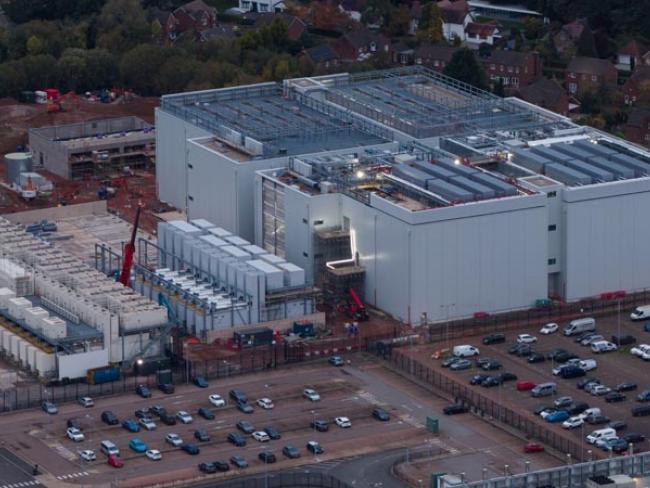
The Vantage Data Centre in Cardiff, one of the largest in Europe. It uses as much electricity as a medium-sized town. Photo Aerials/shutterstock.com.
Britain is being covered with vast data centres. Workers are going to face even bigger utility bills as a result. And a great deal of the power they consume is used keeping track of the population…
The unpleasant side effects of the seemingly unstoppable rise in the number of data centres in Britain are beginning to emerge. These “giant warehouses full of powerful computers used to run digital services from movie streaming to online banking”, as the BBC described them, drain energy from the national grid, and put grid infrastructure under huge strain.
Just one example: in December 2025 a report from London’s City Hall said that in 2022 housing developments in West London were told they would have to wait until 2037 for a grid connection. West London is particularly favoured by companies looking to locate data centres. And the problem is not confined to London.
These problems, though, are just the tip of an iceberg heading for the British economy. In January 2025 the government said that data centre usage accounted for 2.5 per cent of energy use. That is set to rise fourfold by the end of 2025.
At the time of writing, industry market research company Baxtel counts 508 data centres in Britain, with a further 43 under construction. As of November 2025, according to The Times, another 100 are going through the planning process. This is a new industrial revolution.
The stark facts are that modern data handling requires vast amounts of power generation and backup generation to keep the computers cool. They generate a lot of heat to compute and move data.
Industrial scale
A large data centre is an industrial-scale operation. One of the largest in Britain (and Europe), the Vantage data centre in Cardiff, when fully operational, will use 158 megawatts, as much electricity as a medium-sized town.
The International Energy Agency says electricity demand from data centres worldwide is set to more than double by 2030 to around 945 terawatt-hours (TWh), slightly more than the entire electricity consumption of Japan today. AI will be the most significant driver of this increase. Electricity demand from AI-optimised data centres is projected to more than quadruple by 2030.
For example, a report from Loughborough University in January 2025 predicted that by as soon as 2030 AI and related infrastructure could amount to fully a quarter of total British electricity consumption in 2021.
This massive energy draw for these AI and data centres is affecting electricity prices for the working class. It is not easy to separate out their effect on prices in Britain. But a 2025 analysis by Bloomberg of wholesale electricity prices across the US shows that electricity now costs as much as 267 per cent more for a single month than it did five years ago in areas “located near significant data center activity”.
Other utilities are affected, too. To keep these facilities cool requires significant water, air or refrigeration systems. Often data centres are sited close to open seas but smaller “hubs” or bespoke centres for certain companies may be sited in or near towns and cities inland and may make use of local water and electricity supplies, leading to stress at certain times.
Concerns about the huge amount of energy and water the new data centres will consume are obviously an issue for local authorities. And yet Britain has minimal planning constraints as data centres are classed as warehouses rather than industrial sites.
US funders
More than half of the new data centres would be in London and neighbouring counties. Many are privately funded by US tech giants such as Google and Microsoft and major investment firms.
Microsoft is planning four new data centres in Britain, with an estimated completion between 2027 and 2029 – two in the Leeds area, one near Newport in Wales, and a five-storey site in Acton, north-west London. In September Microsoft said that it will invest $30 billion in total in what it calls AI infrastructure and ongoing operations from 2025 to 2028. Half of that will go on capital expenditure on infrastructure.
And in September 2025, Google opened a data centre in Hertfordshire, an investment worth £740 million, which it says will use air rather than water to cool its servers.
‘Modern data handling requires vast amounts of power and backup generation to keep the computers cool…’
While the BBC talks about using data centres for digital banking and video streaming, the real driver for more and more data centre capacity is AI. Much of this – it’s impossible to say how much because data centres are notoriously cagey about it – will be used to track and control populations.
It does, though, take masses of energy for the ruling class to track a whole population, and power will be made available to the data centres needed to process the AI – come what may. If that means energy price rises for the working class to pay for the infrastructure needed, so be it.
Bills
A report by the National Energy System Operator in mid 2025, as well as forecasting what the energy mix might be, expects to see electricity demand increase from 290 TWh today to as much as 785 TWh by 2050. That will cost serious money. Expect equally serious rises in electricity bills.
Using AI to generate video is energy-intensive enough: a five-second clip is estimated to use as much energy as running a microwave for an hour. The same goes for using video of crowds to identify individuals.
According to the government, as of November 2025 13 police forces in England and Wales are using live facial recognition (LFR), including the Metropolitan Police. In LFR, crowds are scanned to search for “persons of interest”.
And that’s not all. There’s also retrospective facial recognition (RFR) via the Police National Database, where footage of all kinds can be scanned and people checked against a national database. The government says that RFR is leading to more than 25,000 facial images searches every month – on top of searches via local databases.
With the advances of video-generated AI and bots on social media, the ruling class will attempt to use this technology to manipulate people to retain their class domination. In effect, information warfare on workers.
We have an insight into this warfare with Facebook’s Cambridge Analytica scandal, pinpointing populations to target them with adverts to sway their voting. Or more recently Israeli “geofencing” of American churches in USA with pro-Israeli messaging. AI will supercharge this kind of activity.
• Related article: Centre for energy consumption