
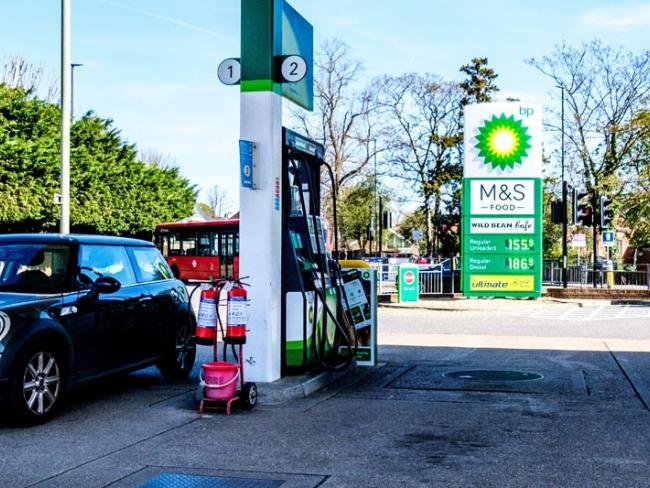
Surging pump prices for petrol and diesel are just the tip of the iceberg. Photo Richard M Lee/shutterstock.com.
War means that prices, and taxes, go up. It is both a cause of inflation and an excuse for government and employers to pass off a systemic element of capitalism as nothing to do with them…
Regardless of the ins and outs of the war on Iran and whether or not there’s a ceasefire, the outcome for British workers will be more inflation. This comes on top of the post-2022 cumulative inflation of 35 per cent which at its outset the government described as transitory.
The pent up inflation in the pipeline is already being depicted as an “oil shock” – as if all would have been well but for the US and Israel attacking Iran. From this “shock” we can expect much hand wringing from the government actors. But all the while, they are quietly content in the knowledge that inflation is a class weapon used to repress British workers.
The government attraction to inflation is that it is a weapon they can hide behind. For example they say they didn’t see inflation coming yet ignore the obvious and predictable impact of government money printing (“quantitative easing”). Or as in 2022 they said it’s because Russia invaded Ukraine. Now they blame inflation on an “oil shock” due to war.
Warmongering
Where war is the immediate cause for price rises, remember that British governments never pass the opportunity to cheer on or engage in an overseas war. Keir Starmer’s foreign crusade from day one was to be the leader of the NATO pack.
Who is fooled by Starmer’s disingenuous statements about standing up to Trump and not being involved in attacking Iran? Allowing the US to launch continuous strikes on Iran from British bases is merely the latest example of his complicity in warmaking.
History does not always repeat itself. But it is worth considering what happened in Britain in the early 1980s. Inflation (measured by RPI) for 1980 was 18 per cent followed by further increases of 12 per cent in 1981 and 9 per cent in 1982. These price hikes coincided with the outbreak of the Iran/Iraq war – where western powers encouraged the Saddam Hussein-led Iraq government to attack Iran.
At the same time, the British Thatcher government led a manic attack on Britain’s industrial base and service provisions too. They claimed that our industry was uneconomic. This onslaught of industrial closure and service cuts was accompanied by the slogan “the fight against inflation”.
The lie they propagated was that inflation was caused by trade unions fighting to maintain the purchasing power of their members’ wages. All the while making little mention of the oil price hike due to the Iraq/Iran conflict. Behind the scenes Thatcher’s government described its policy of industrial closure as “shock therapy” – to the cheers of the employers and ruling class.
RPI is up around 35 per cent since 2022. Active pay fights in many areas have limited the impact – but only to some extent. Struggles to recoup the damage of long-term real pay cuts continue, but have rarely made inroads. And there are signs now that employers are responding with threats of cuts to jobs and conditions (which inhibit pay demands too) – on the back of increases in costs, and taxes.
Inflation equals diminished working class purchasing power – that’s clear. But it also diminishes the public debt in real terms.
Pauperisation
Now we have an external threat of inflation (oil and gas and so on) meaning workers’ purchasing power is set to fall even further but public debt in real terms will further shrink. In government management of the post-2008 public debt, money printing is being inflated away while the British working class is being pauperised.
In 2026, how can workers break from this ever-tightening, vicious, spiral?
In reply, a simple question to ask is – why have British oil prices this year increased at all when our oil is sourced from British waters in the North Sea as well as from places like Norway?
The answer is that oil prices in Britain are determined internationally, index-linked to global rather than local prices.
In effect North Sea oil production has no allegiance to Britain or for Britain to benefit at a lower price than international market prices. This straightforward point is skipped over in popular media and by politicians.
They like to say something like this, “North Sea oil development would neither reduce domestic bills nor improve energy security, since prices are set globally and much UK oil is exported internationally”.
Break from the global index
To break from this unquestioning adherence to a global price index, all current and future oil production in British waters including recent new discoveries and future exploration should be subject to an export ban. Then our oil and gas would be reserved solely for British domestic use. Our oil should also be priced in British pounds not in US dollars.
All current and future oil production in British waters should be subject to an export ban, reserved solely for
domestic use…’
‘This would require the regulation of all oil producers operating in British waters. Such an idea would create hysterical squeals from government and many of the usual group who say “Britain is weak and finished” – no doubt including the Green lobby who don’t want oil and industry anyway.
The alternative is to be beholden to a global index and to put up with this wretched government’s faux inflation concerns while it is fully aware that inflation is a class weapon used to repress workers.
Looking at things through this lens enables events including imperialist war and inflation to be understood for what they are, namely a conscious attack on workers here and elsewhere. The fight for wages is the fight for peace.