
1 July 2026
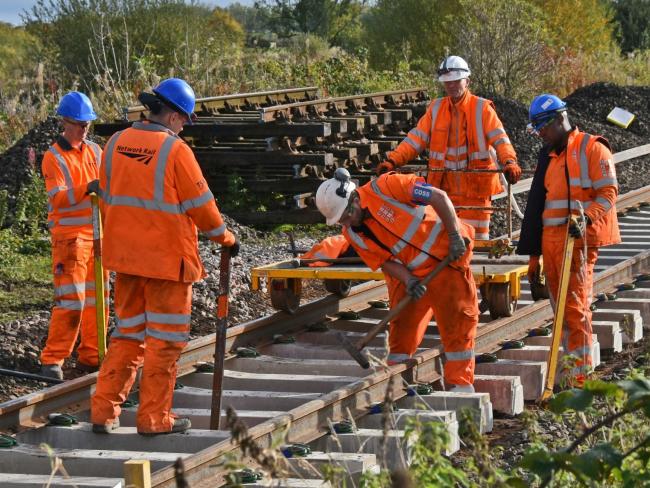
National Rail engineers working near York. It is responsible for maintaining railway track across the country but private contractors carry out major renewals. Photo M Barratt/Shutterstock.
The Balfour Beatty rail engineering depot at Crewe is threatened with closure. This threatens 67 skilled jobs there and in Preston. This will further undermine the loss of expertise in the industry.
Their union RMT, supported by the TUC, has demanded that the government intervene to protect these jobs. They say this is more than a simple commercial decision and reflects problems in the wider structure of the railways.
Private
Railway infrastructure was nationalised under Network Rail over 20 years ago. And more recently the government decided to gradually return passenger operators to the public sector, a process that is nearly complete.
The Balfour Beatty workers are some of many still in the private sector even after government decisions to partially nationalise the railways.
Contractors
Network Rail maintains the railway using its own workforce. But it continues to employ contractors like Balfour Beatty to carry out renewal of track, signalling, and electrical power systems.
Before privatisation of the railways in the 1990s, most renewals were carried out by British Rail’s directly employed staff. From 1994 to 2002 a private company, Railtrack, was responsible for the infrastructure. A series of accidents and financial difficulties resulted in transfer back to the public sector.
Constraints
Network Rail currently operates under government funding constraints. Renewals work has been deferred. Ageing infrastructure assets are nursed along with “reactive maintenance” – a term for “when it breaks, it we will fix it”. This approach has led to the current threat to jobs at Balfour Beatty.
‘A greater need for skilled rail workers in the future – not cuts.’
The backlog of rail renewals is growing. That means a greater need for skilled rail workers in the future – not cuts. RMT and the TUC warned that allowing the loss of such staff would further weaken the industry’s skills base.
A motion to Parliament criticising the redundancies quotes a RMT estimate of £4.7 billion in profits made by private companies from rail contracts since 1996. And it says a total of £236 million was extracted by contractors in profits last year from Network Rail’s renewals work.
Balfour Beatty’s finances appear healthy. Worldwide profits for 2025 were £323 million, up by over 50 per cent and shareholders expect a total return £267 million this year of in dividends and share buy backs.
Crisis
The government has already acknowledged a the workforce crisis across the railway. The National Skills Academy for Rail estimates that there will be a shortage of around 1,000 skilled rail engineers by next year.
In their joint letter to ministers, RMT and TUC argued that the threatened job losses are directly linked to Network Rail funding decisions. This could be mitigated through the allocation of alternative work.
Protect
RMT has called on Network Rail to take action to protect rail infrastructure jobs by working with the RMT to begin insourcing renewals workers.
Experience shows that once such skilled workers are made redundant, they move on to other sectors. They are not then available when there is an upturn in rail work.