
16 January 2026
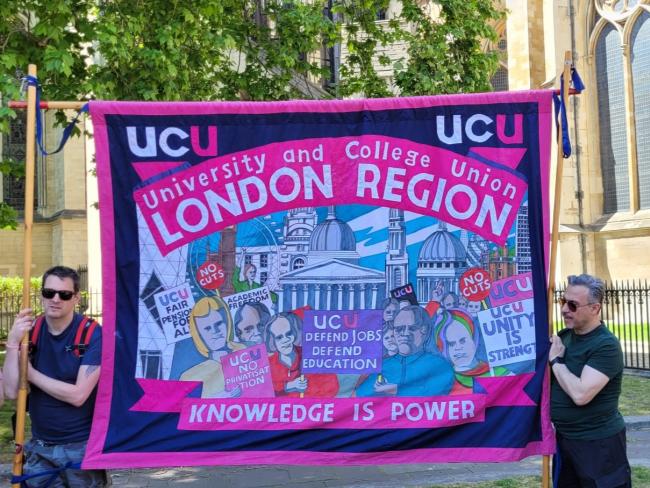
UCU members demonstrating to protect education, London, May 2025. Photo Workers.
University and College Union (UCU) members across the country continue to fight in defence of their jobs, pensions and conditions. These struggles are vital if Britain is to have the further and higher education system it needs in order to flourish as an advanced, educated industrial nation.
In their dispute on pay and conditions, 17 further education colleges in England have been on strike this week from 14 to 16 January. Over 20 FE colleges have already won pay awards. The UCU is campaigning for a new deal for the sector – which the government supposedly recognises as important for skills development.
Reality
The union is running a separate campaign to stop cuts in the higher education sector. And again the government offered many fine words in the Post-16 education and skills white paper in November, saying that quality HE is key to growth. Except that the reality is different, many areas face cuts.
Southampton Solent University UCU members voted to strike over conditions and jobs. their employer had forced hundreds of staff out of their preferred pension scheme and onto new contracts, while threatening to sack those who refused to be moved. Over 90 per cent voted to back strike action on a turnout of 72 per cent.
Jobs axe
University of Essex UCU members are balloting for strike action over plans to close the Southend campus and to axe 400 jobs, both academic and professional services. The ballot will close on Monday 19 January. The university wrote to all 2,974 members of staff to tell them they were at risk of redundancy just as they were breaking up for the Christmas holidays.
Northumbria University UCU members are also balloting for strike action, in their fight against the employer’s effort to force them to leave the Teachers’ Pension Scheme. The ballot closes on 23 January. It comes after UCU members overwhelmingly passed a motion of no confidence in the vice-chancellor and university executive team.
Closing courses
University of Leicester UCU members have already taken five weeks of action and will be taking a further three days on 22, 23 and 26 January against compulsory job losses. The employer wants to close or merge several subjects – including modern languages; film studies; chemistry; and geography, geology and environment. It also proposes restructuring and downgrading professional services staff.
Leicester workers expect further proposals and more job losses for other areas – education, history, and technical and research support services. In a recent vote, 96 per cent of staff and students expressed no confidence in the vice-chancellor.
Overwhelming vote
Shortly before Christmas, University of Sheffield International College members voted overwhelmingly for strike action in their dispute over pay and conditions. On a turnout of 61 per cent, 90 per cent of those that took part voted for strike action, and 100 per cent backed action short of a strike.
Durham University UCU members are challenging their employer over refusal to engage constructively with the union over untenable workloads and worsening job insecurity. Their strike ballot is due to run until 6 February.
Scotland
Universities in Scotland are part of this national effort. Strike ballots over job losses and compulsory redundancies opened in early January at Aberdeen, Heriot-Watt, Stirling and Strathclyde universities.
Meanwhile, UCU members at the University of Edinburgh have made significant progress in their dispute with the employer over job cuts, and University of the Highlands and Islands UCU have resolved their dispute over compulsory redundancies.