
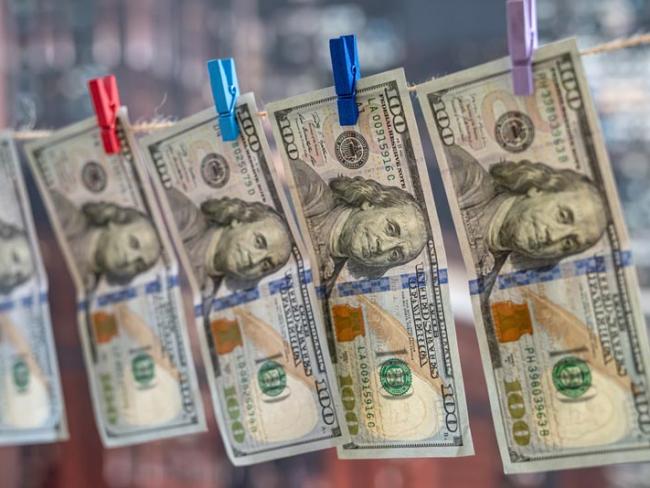
High-value notes are boon for the launderers. Photo RomanR/shutterstock.com.
A system created to serve the needs of tax dodgers has become an ideal vehicle for gangsters, fraudsters and terrorists of all stripes…
Everybody loves our dollars: how money laundering won, by Oliver Bullough, hardback, 311 pages, ISBN 978-1399618090, Weidenfeld & Nicolson, 2026, £25. Kindle and eBook editions available. Paperback edition due January 2027.
This outstanding book describes the growing money laundering system. An alliance between greedy tax dodgers and compliant politicians created this system, used by gangsters, fraudsters, terrorists and kleptocrats to launder their wealth.
The author, Oliver Bullough, is an investigative journalist specialising in financial crime. Workers reviewed one of his previous books, Butler to the World, in September/October 2022. That looked at the role of Britain’s institutions in servicing dirty money and the people who control it. This one takes a look worldwide.
The governments of the G7 countries let money flow freely through the world’s financial system. These governments all serve finance capital, which is wedded to the free movement of capital, labour, goods and services. But so is the criminal underworld. In fact, one might almost say that finance capital and the criminal underworld are two sides of the same coin – a unity of capitalism and criminality.
The governments profit from this freedom by printing vast numbers of bank-notes, especially high-value ones like $100 notes. How do criminals launder money? Mostly by using cash, as they always have done.
To stop producing these big notes is such an obvious thing to do – which raises the question, why hasn’t it been done? Perhaps because the US government in particular makes huge profits by providing the currency of the global criminal underworld. It exchanges pieces of paper, which cost almost nothing to print, for manufactured goods.
Cryptocurrencies
The US government has also unleashed an environment where crypto-currencies like Bitcoin (the largest) and Tether (a so-called “stablecoin”) thrive. These provide highly efficient ways to launder money – and are openly designed to evade the monetary controls and policies of nation states.
Despite that aim, a big share of the profits from stablecoin accrue largely to the US government. That means that the more of them there are, then the more money flows to the US Treasury.
Russian authorities use stablecoin to evade the sanctions put on their financial system and to trade oil unimpeded. Hamas, Hezbollah, ISIS and other terrorists have used stablecoin to attract donations, move money and fund their activities, all without governments being able to stop them.
The commander of the US Southern Command, part of the US military responsible for security in the Caribbean, Central and South America, told a Senate committee in 2021 that Chinese money laundering is “the number one underwriter of transnational criminal organisations”.
For example, the Chinese Underground Banking System sources cash from criminal groups all over Britain involved in drug trafficking, organised immigration crime and human trafficking. Albanian gangsters have gained control of the European cocaine market because they have outsourced money laundering to the Chinese. All the Mexican cartels move their money via Chinese gangs.
Anonymity for criminals
Governments allow the sale of anonymous companies that let criminals hide their ownership of bank accounts, which is a key part of laundering their wealth. The best places to get anonymous shell companies have long been US states like Delaware and Nevada. They add a veneer of respectability that offshore tax havens such as the British Virgin Islands and the Cayman Islands might lack.
The US government passed a law that mandates the collection of the names of people behind the shell companies. It was effective from the start of 2024, but President Trump has said he won’t enforce it. The US administration has also pardoned a succession of financial criminals.
Britain too has always provided a ready source of dodgy shell companies. And supposed controls are ineffective, for example rules on overseas property ownership don’t reveal the real owners.
‘Britain has always provided a ready source of dodgy shell companies…’
The EU has, characteristically, gone backwards, while claiming it is increasing controls. A 2022 ruling by the European Court of Justice effectively closed public registers of company ownership on the ground of “privacy rights”. A wealthy Russian objected to his name being made public and won the court case.
Politicians have also created an anti-money laundering system, which somehow constantly fails. Indeed, it almost seems designed to fail. It is supposed to make money laundering prohibitively costly and thus unprofitable. But it doesn’t work, because it is still so easy to move cash in its physical form. Which means that all its rules, compliance and debanking are achieving nothing.
Regulation and sanction against money laundering tends to focus on the misdeeds of very small operators. In 2000, the US Financial Action Task Force issued a blacklist of 15 countries guilty of money laundering.
With the exception of the Cayman Islands, no British territories were blacklisted, not the British Virgin Islands, not Bermuda, not Anguilla, not Gibraltar, not Jersey, not the Isle of Man, not the UK itself. London was then and is now the world’s biggest offshore banking centre. All the above had laundered far more money than most of those on the list.
Investigative journalists have exposed the scale and methods behind money laundering, for example with the Panama Papers in 2016 and the Pandora Papers in 2021. Yet the pursuit and prosecution of those involved is patchy and limited. This book helps illustrate why it will remain so.