
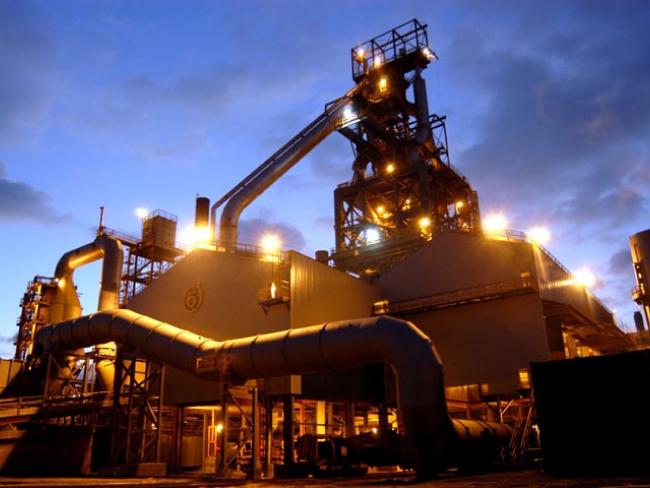
One of the blast furnaces at Port Talbot steelworks in 2007 when operational. The last one closed in 2024, but the need for steel continues. Photo Grubb/Wikimedia (Public Domain).
On 19 March the government announced its steel strategy, including import tariffs. But there are wider challenges to face to secure the vital industry, particularly the cost of energy…
The British government has taken a small step towards securing Britain’s steel industry with the announcement of a steel strategy. But limited action on tariffs serves only to highlight the inadequacy of its plans and the scale of the challenge.
On 19 March the business secretary Peter Kyle visited Tata Steel in Port Talbot, South Wales to meet steelworkers (those that are left). He used the occasion for the long-awaited launch of the government’s steel strategy.
The stated aim of the strategy is to boost domestic production so that it can meet up to half of Britain’s domestic demand for steel. And it claims to set out a path to secure the industry’s role in supporting vital sectors like infrastructure, defence and clean energy.
British steel producers and thousands of steel workers from Glasgow to Port Talbot will be assessing the new strategy. They will ask whether it will in fact protect domestic steelmaking and build more resilience in the supply chain.
It has taken a year since the government consulted on plans for steel. In the meanwhile the industry is increasingly vulnerable.
There are several reasons for this vulnerability: the long time scale for creating new capacity; uncertainty about the replacement of coal-fired blast furnaces by electric-powered ones; the unclear intentions of the foreign companies that now own the steelmakers; the unpredictable impact of tariffs imposed and disputed by the USA, China and the EU.
Energy
But above all the future for steelmaking in Britain is tied to government energy policy and net zero targets. They lead to high energy prices and inevitable demands from some industrial sectors to source steel from abroad.
The government will provide up to £2.5 billion of financing for investment in the steel sector in the life of this parliament. The steel strategy is claimed to be a vital part of the government’s strategic approach to British industry. That seems tenuous at best.
From 1 July 2026, overall quota levels for steel imports will be significantly reduced by 60 per cent, compared to current arrangements. Steel imported into Britain above these new quota levels will be subject to a 50 per cent tariff. It will apply to imported steel products where they can be made in Britain.
Essential
Steel is essential for a nation’s industry and infrastructure. And the capacity to make steel is important for national sovereignty and independence. The new tariff measure is designed to protect British steel production in the face of global steel overcapacity.
Without action, Britain’s steelmaking capability is in real jeopardy. The lack of basic steelmaking would leave the country reliant on overseas suppliers.
To be effective the approach must be truly strategic – encompassing new technologies as well as procurement polices for major projects. Otherwise the risk is that downstream industry – steel fabrication, shipbuilding and the like – leaves Britain.
For example, the strategy states that electric arc furnaces are the way forward. But Tata says that the addition of a direct reduced iron plant, which can produce high quality steel from electric furnaces, depends on government support and competitively priced energy.
‘Energy policy and net zero targets lead to high energy prices and inevitable demands to source steel from abroad…’
And analysis, such as a paper titled Premeditated Industrial Destruction? from the Great British Business Council think tank, makes it clear that without a change to British energy prices and the underpinning policy, even the remaining steel industry won’t last (the same goes for aluminium production too).
Unless the British steel industry can continue to make high quality steel – a sector in which it has excelled – then users such as the aerospace industry will import supplies from abroad; tariffs would not apply. Or worse, that provides an incentive to move the highly skilled manufacturing out of Britain.
Unite, one of the industry trade unions, has welcomed the government’s imposition of steel tariffs to safeguard jobs and industry. But in line with its long-standing policy, the union says that proactive policies that provide long-term stability are essential in ensuring a successful future for the industry.
Unite general secretary Sharon Graham expressed doubts that the government has yet grasped the point. She said: “…this last minute situation is just another reminder that the reactive approach to UK steel that sees it lurch from crisis to crisis needs to be overhauled.”
Think long term
She said there should be a long-term strategy, which “…includes legislating that all UK infrastructure developments and public sector projects use steel made in Britain”.
Unite regional secretary Peter Hughes provided further detail, describing the strategy as only a first step in backing the industry, a foundation for Britain’s economy. He said, “…the government must also back the production of virgin green steel as we can’t simply rely on electric arc furnaces, to produce all the steel we need.”
The other two main unions in the industry have made less of the limitations and needs highlighted by Unite. The response from Community was almost sycophantic in praise of the Labour government and its approach to the industry. And GMB said much the same, though it did say that questions on ownership and the technology mix need spelling out.
• This is a slightly updated version of an article first published online in March on www.cpbml.org.uk.